WeMatch
An AX travel-compatibility companion for the group-travel platform WeRoad. It helps travelers find the right group, not just the right trip: reading how someone travels, building a behavioral profile, scoring each group against it, and explaining every match in plain language.
- Role
- Research · AX design · story
- Year
- 2026
- Host
- SUPSI × Spark Reply
- Scope
- Team of five
- Shipped
- Presentation, testable agent, scrollytelling story
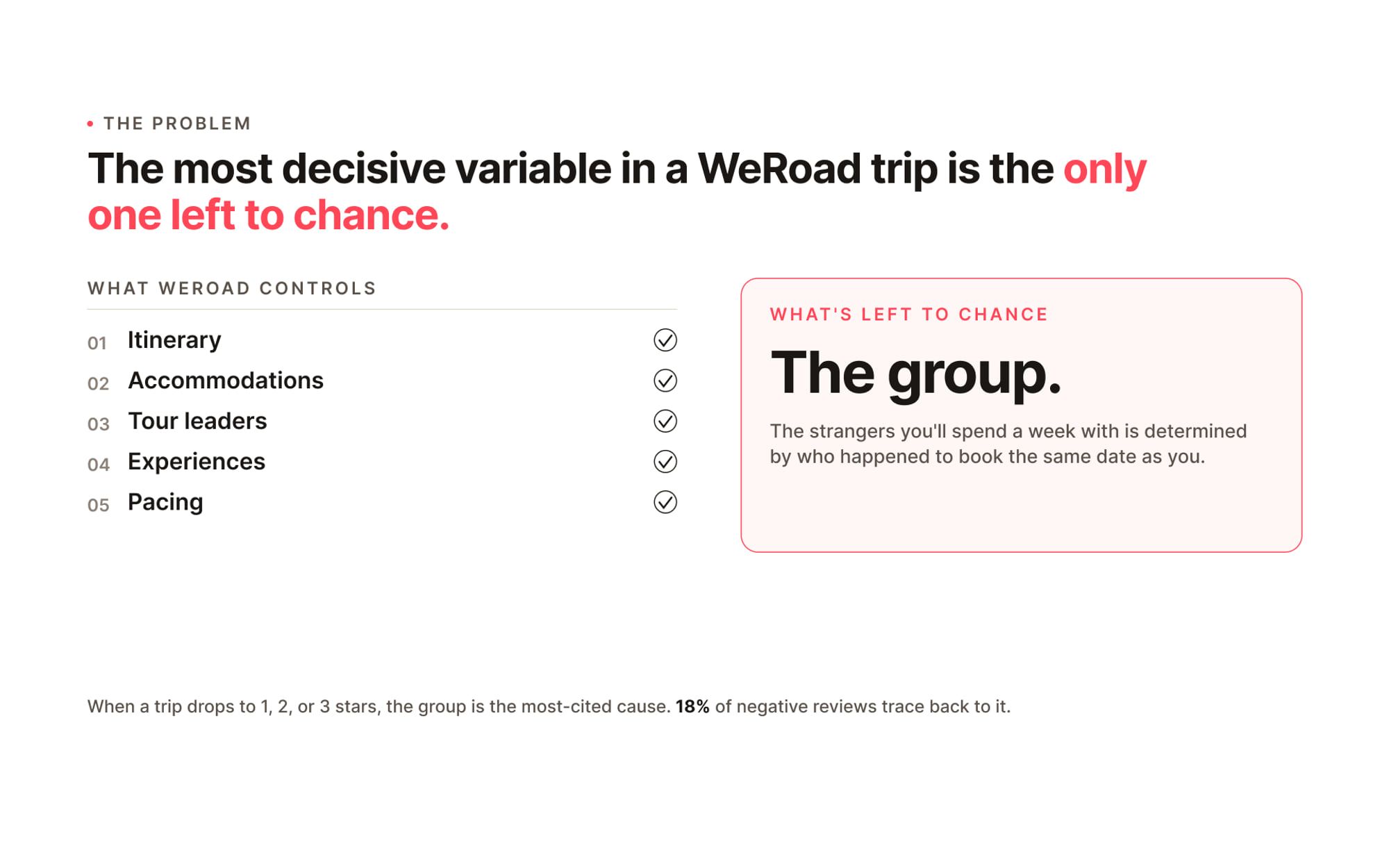
WeRoad designs everything about a group trip except the one thing that decides how it goes. The itinerary, the hotels, the tour leaders, the pacing: all planned. The group, the eleven strangers you will spend ten days with, is left to whoever happened to book the same dates.
The reviews say it out loud. Across 1'660 recent WeRoad reviews on Trustpilot, 58% mention the group or the people they traveled with, more than the destination, the food, the hotels, or the tour leaders. And when a trip fails, the group is the most-cited cause: 18% of negative reviews trace back to it.
Same brand, same itinerary, opposite trip. One traveler comes home from Morocco with people they will hardly forget. Another endures toxic group dynamics in China from the second day. The destination sets the expectation; the group shapes the experience. Right now the group is the only variable nobody designs for.
- Trustpilot data analysis, the 1'660-review study behind the 58% and 18% findings
- Agentic experience design, the six-phase agent and the behavioral-DNA matching model
- Design, build, and storytelling of the scrollytelling experience (Nuxt + GSAP)
- Storytelling of the final presentation, with a teammate
- Ideation and UX research (literature review and interviews), shared across the team
- WeRoad is not a client. WeMatch is a speculative, unsolicited concept; the brand is used adjacently.
Team of five for Designing Intelligent Experiences (SUPSI × Spark Reply): Oleksandra Drapushko, Jérémy Martin, Ceren Seçkin, Zeno Tamagni, Elia Miglio.
Three lenses, one finding
The insight came from triangulation, not a hunch. We read the academic record on solo travel, group dynamics, and matchmaking. We ran eight in-depth interviews, 45 to 60 minutes each, with solo and group travelers. And we analyzed WeRoad's reviews at scale. Three independent sources, one repeated finding.
They converged on a single sentence: the destination sets the expectation, but the group shapes the experience. Three findings sharpened it. Trips are evaluated logistically but experienced socially. A traveler's profile shifts with context and time, so static profiling cannot capture it. And a good match has to feel recognizable, because compatibility only convinces when people can see themselves in it.
Groups disguised as trips
The reframe was a single move. We used to say travelers need help finding the right trip. We now say the right trip needs the right group. The catalog of destinations is really a catalog of groups, wearing itineraries.
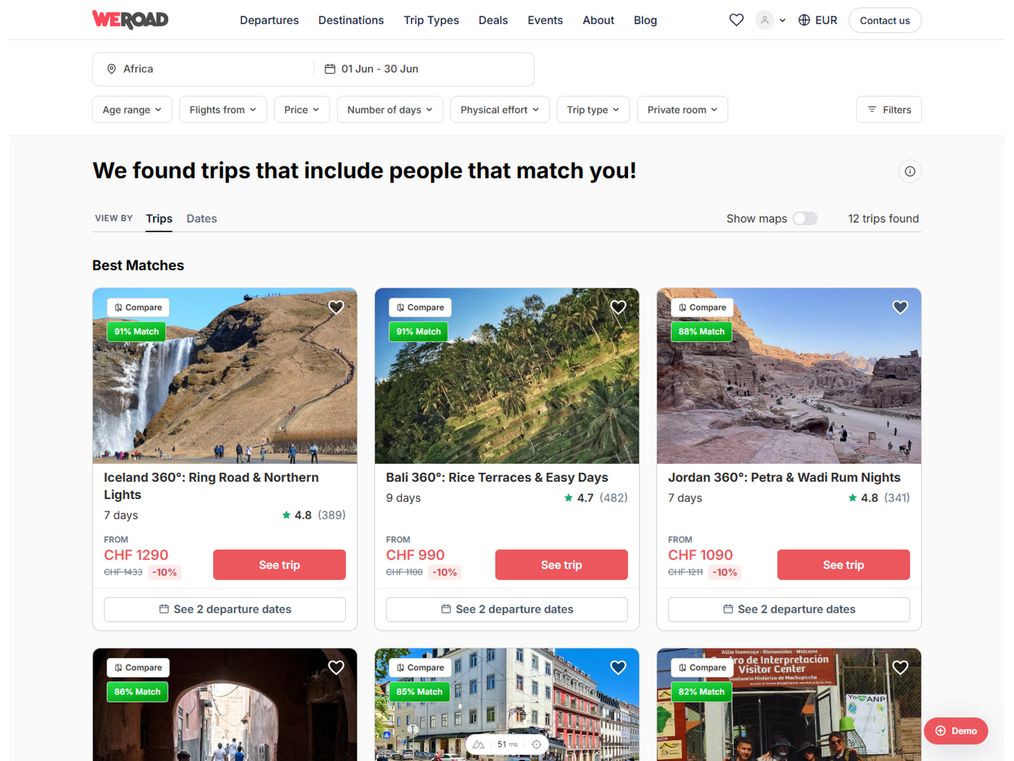
Crucially, nothing is taken away. A traveler still searches by destination, dates, and price exactly as before. What is added is a compatibility score on every trip, and the ability to sort by group fit instead of by date or price. The familiar search stays; one new, readable signal changes what it optimizes for.
One companion, six phases
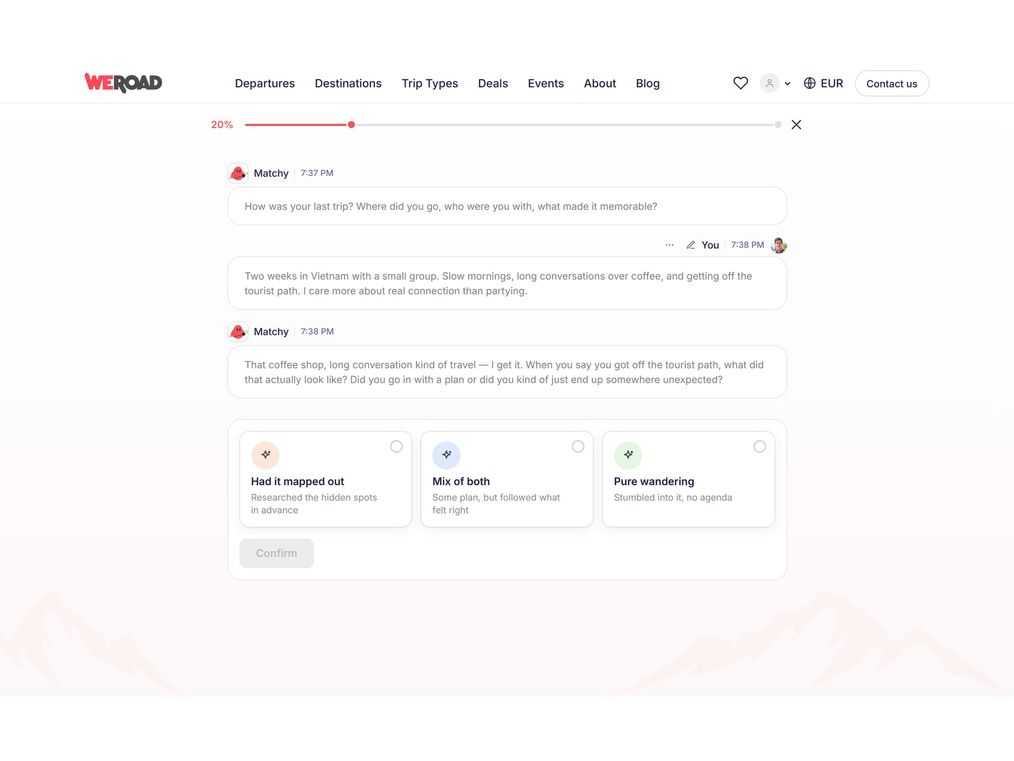
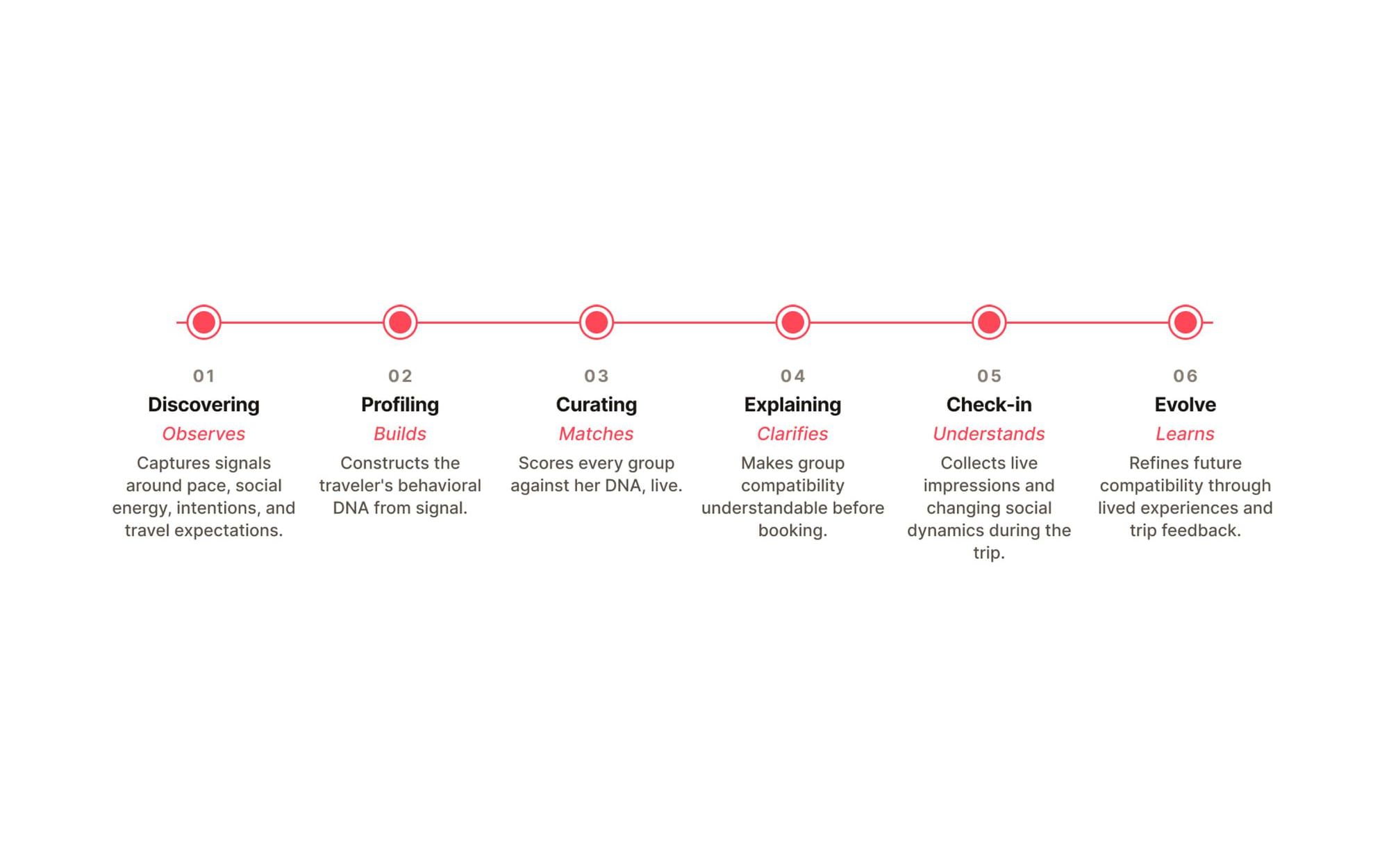
WeMatch is an agent (the team named it Matchy) that accompanies the whole journey rather than a one-off chat. It works in six phases, each a different role. It discovers, capturing signals around pace, social energy, and intent. It profiles, building the traveler's behavioral DNA from those signals. It curates, scoring every group against that DNA.
Then it explains, making each match understandable before booking. It checks in during the trip, reading the live social dynamics. And it evolves, refining future compatibility from lived experience and trip feedback. The arc runs from the first session to long after the traveler comes home.
Behavioral DNA, from signal to match
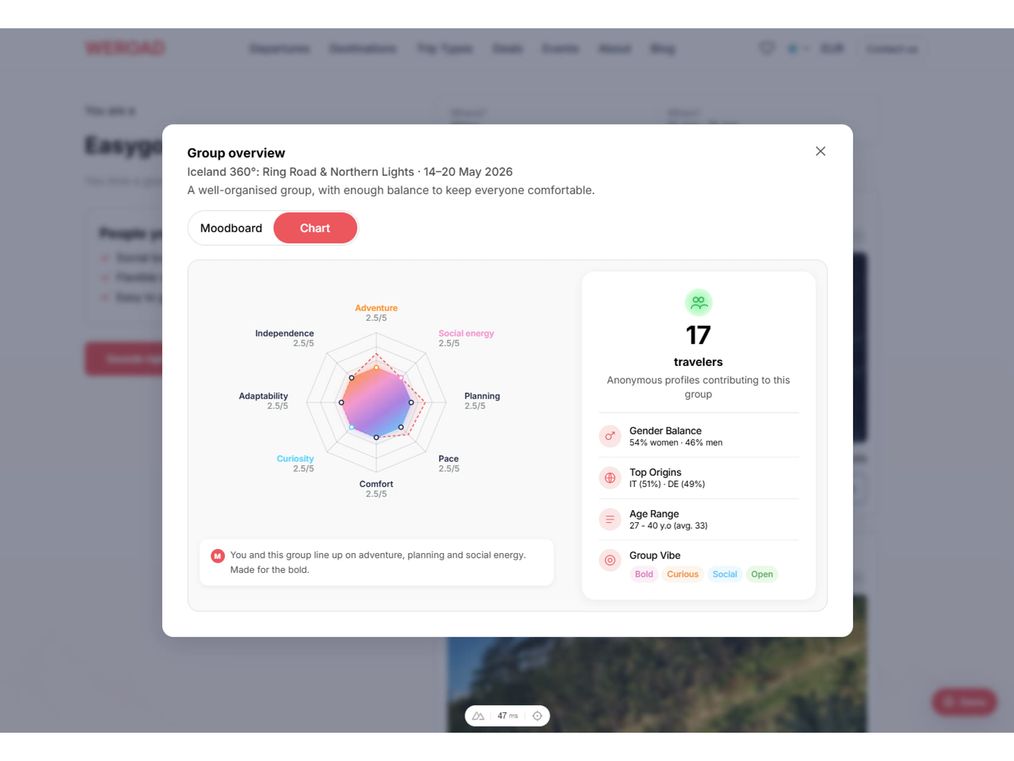
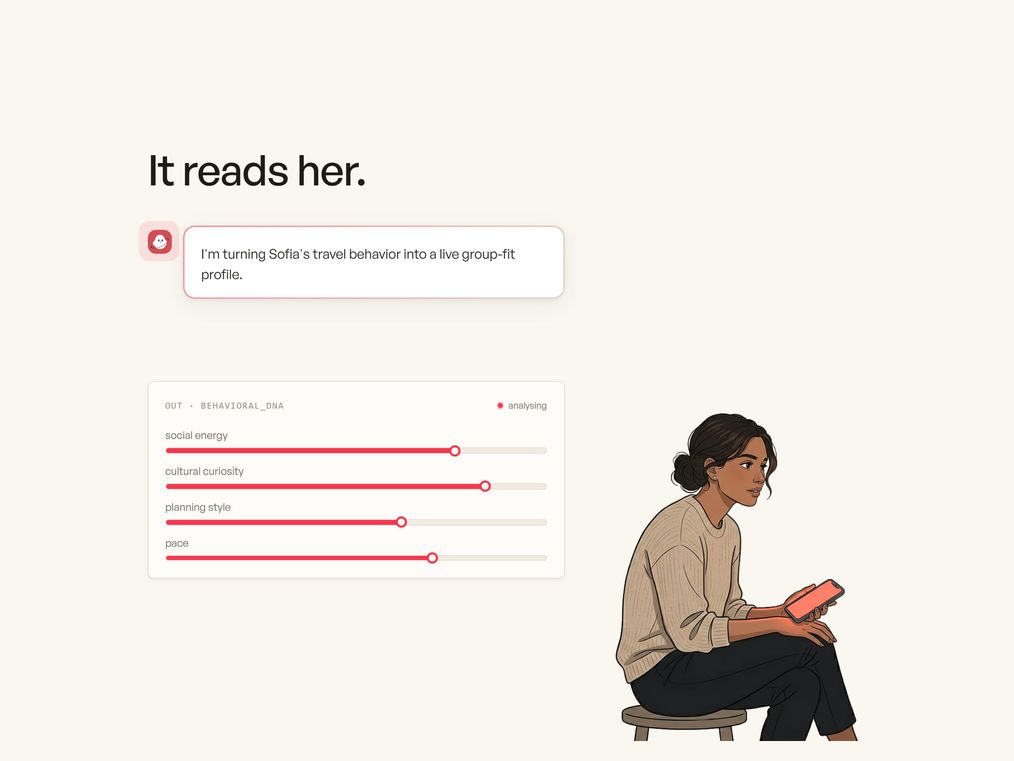
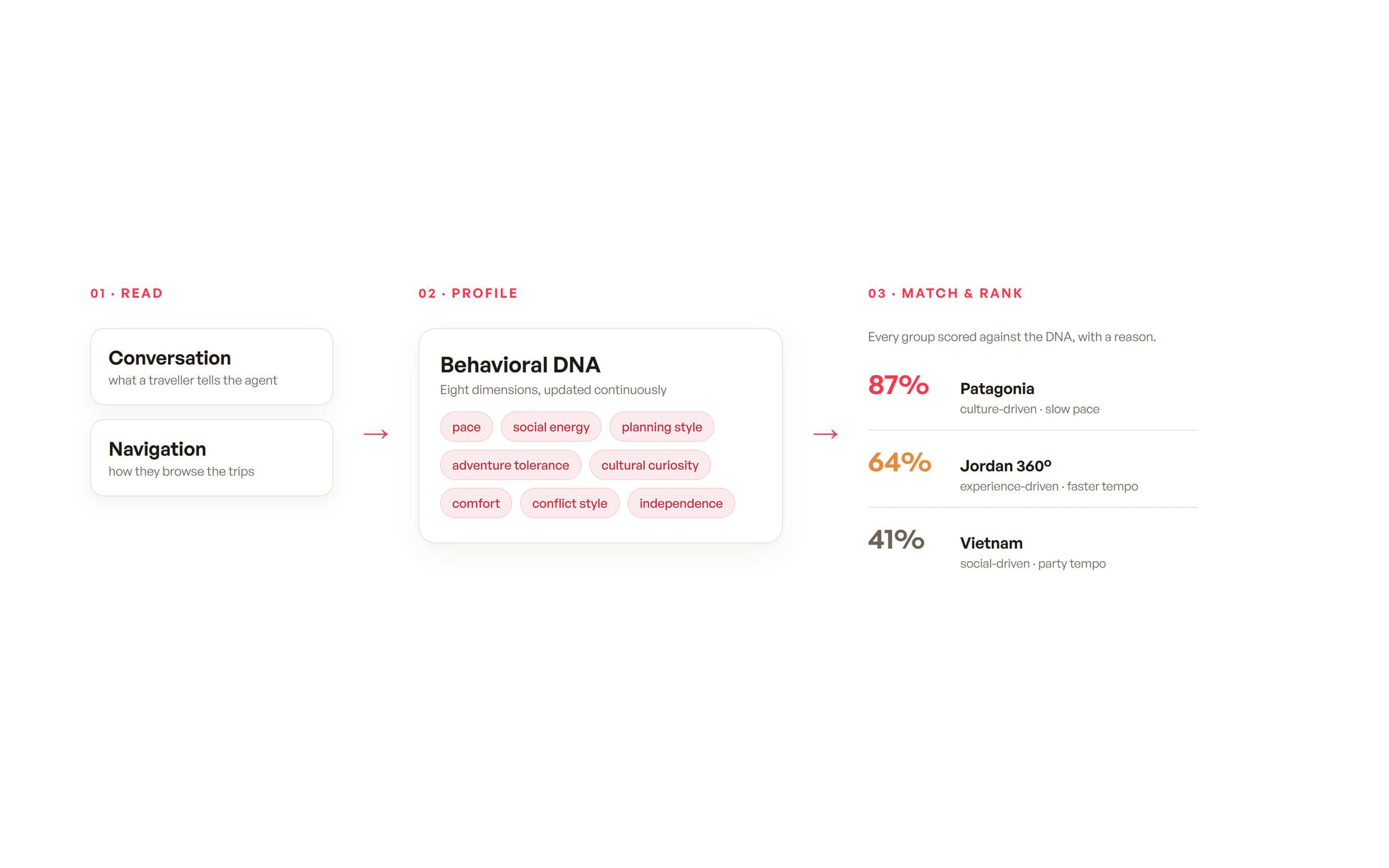
Profiling is the engine. Every other platform ranks trips by destination; WeMatch ranks by compatibility. Two inputs feed one artifact: what a traveler says in conversation, and how they browse the site. Together those build a behavioral DNA across eight dimensions like pace, social energy, planning style, and conflict style, updated continuously from the first session.
Each available group is then scored against that DNA, producing a compatibility percentage and a plain-language reason for every trip. The search re-ranks by group fit: "87%, culture-driven, slow pace, mid-thirties mix" sits above "41%, social-driven, party tempo, younger group." And the profile is visible and editable, so the traveler can see what the agent inferred and correct it, which makes the match more accurate the more they engage.
Communicating an invisible layer
A compatibility layer is hard to show, because the interesting part is invisible. My job on the communication side was to make it land without a feature list, as a scrollytelling experience that follows one traveler deciding whether to book. The reader meets the service the way she would, in motion, rather than being told what it does.
The same logic shaped the final presentation, whose storytelling I built with a teammate. Across both, the rule was the same: show the agent working, never announce it as "AI." The argument is carried by the data, the reframe, and the traveler's own experience, not by the word.
A research-grounded service concept: three independent research lenses converging on one finding, a six-phase agent, and the behavioral-DNA matching model.
Three deliverables shipped: the end-to-end design presentation, a live testable agent, and the scrollytelling story that carries the argument.
Well received in the course, across both the storytelling and the working agent behind it.
The most valuable part wasn't the concept. It was learning the method from a team that builds agentic experiences for real. Spark Reply's AX practice has its own grammar: design around user intent rather than features, give the agent a personality and keep it consistent, and spend genuine time on the edge cases, where an agent's autonomy is most likely to go wrong. That framing reshaped how I design with AI, and it is the lens I bring to the rest of my work now.