Human Loci
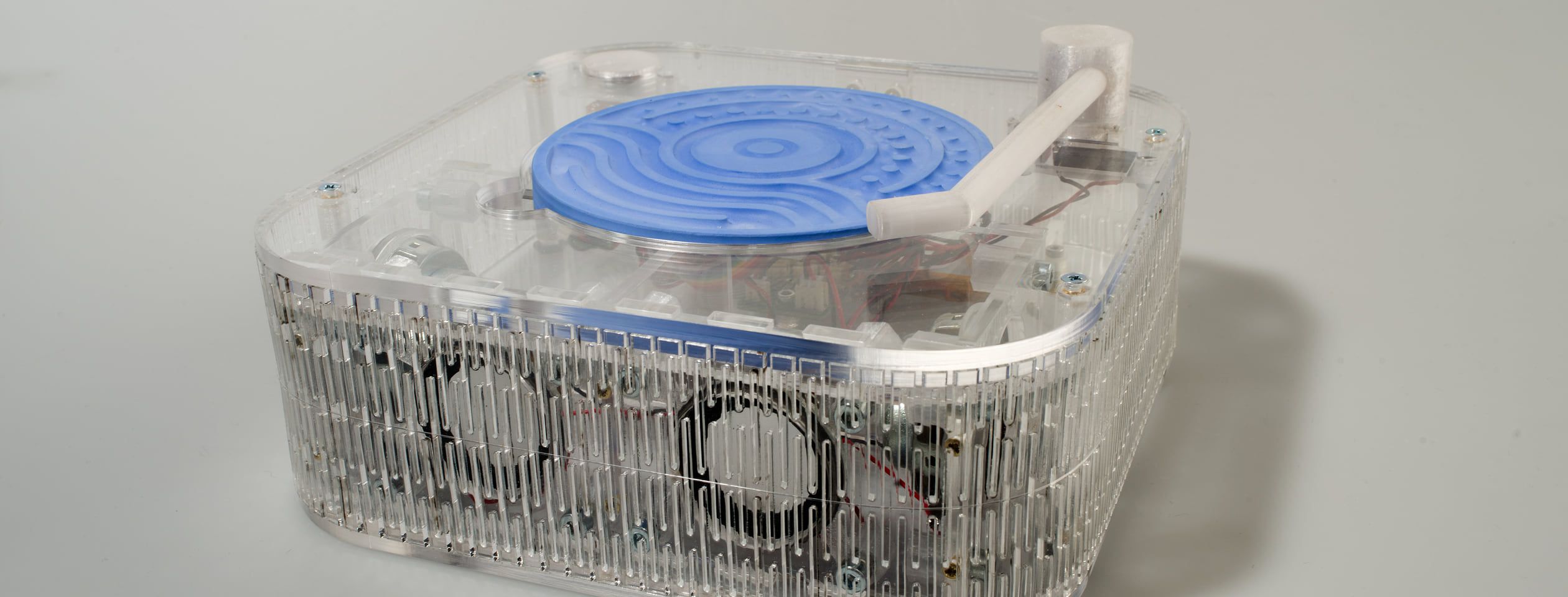
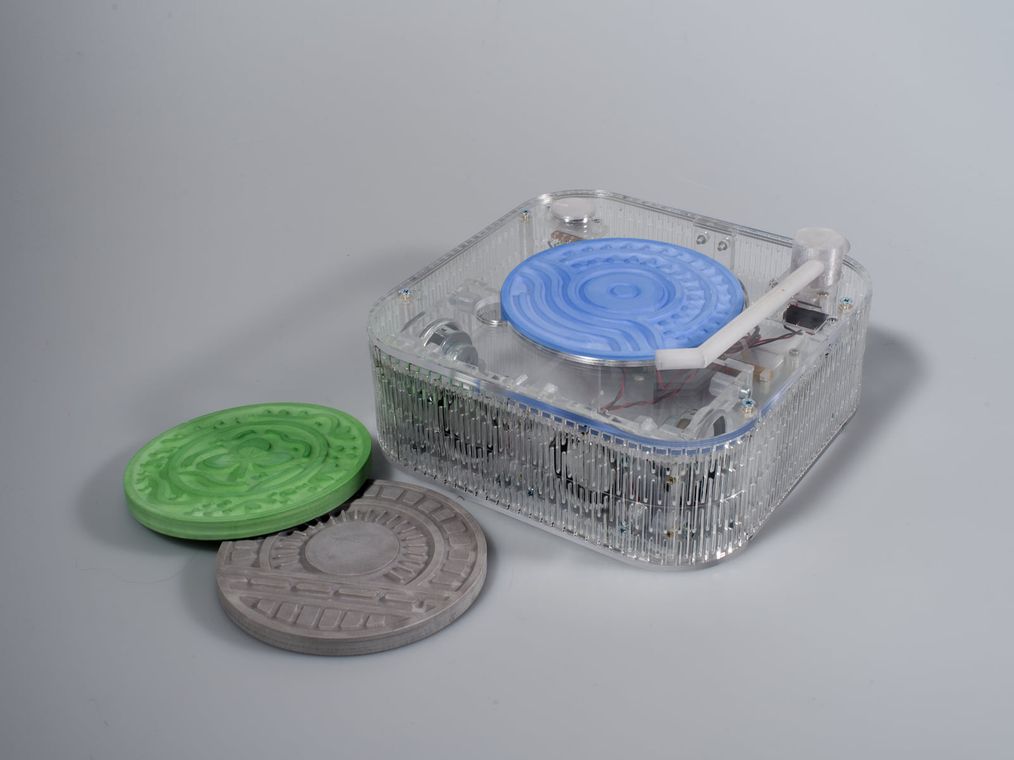
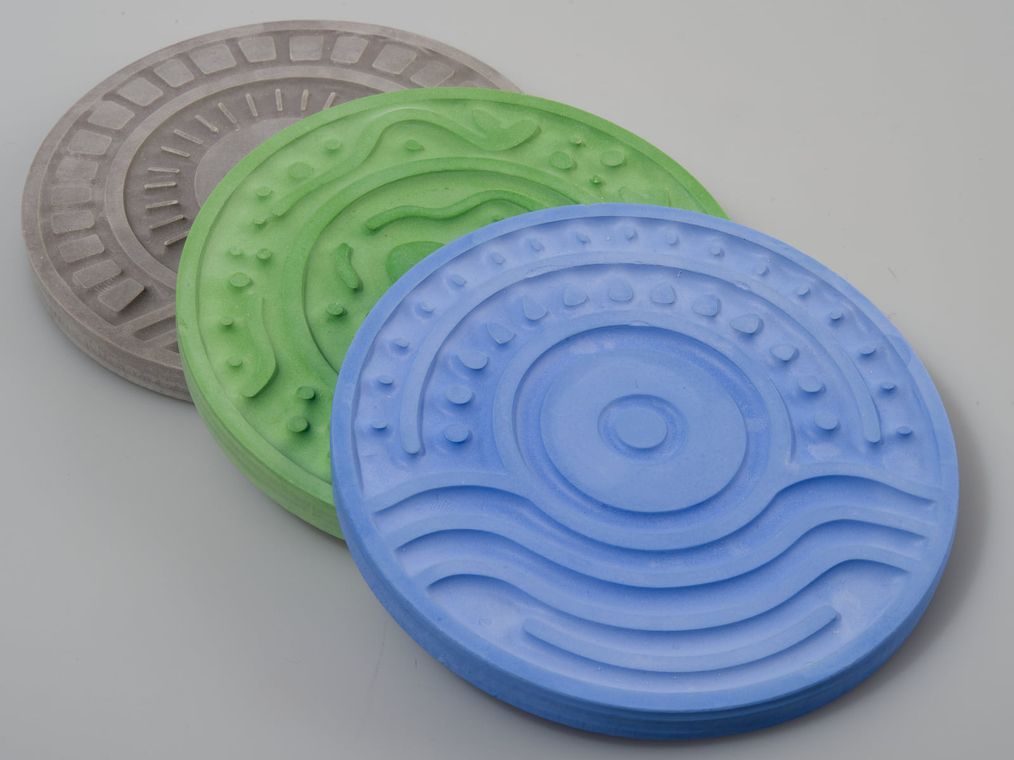
A synesthetic listening object that plays places instead of music. Three plaster disks, each tied to a public space, let you drop its field recording into the room and sit with the atmosphere of somewhere else, chosen by touch before a sound begins.
- Role
- Electronics & enclosure integration
- Year
- 2025
- Host
- SUPSI · ID120
- Scope
- Team of three
- Shipped
- Working prototype
Recorded sound almost always means something made to be heard: music, a podcast, a voice. The ordinary acoustic texture of a public place, a park at midday, a marina, a train station, is just as rich, and we almost never choose to sit with it. It is the layer that usually stays in the background, unnoticed.
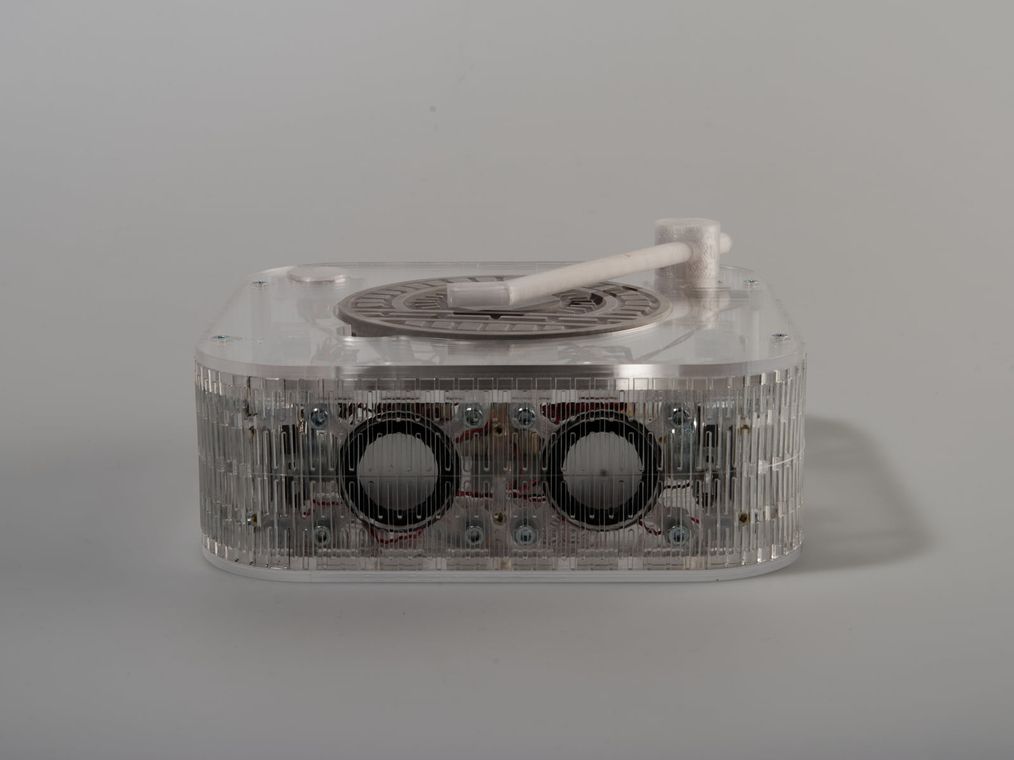
Human Loci is a small machine for listening to exactly that. It does not play music; it plays places. Each one is reconstructed not as an image but as a presence: its rhythms, its density, the human movement that gives it a shape over time. The object is closer to an archive of public moments than to a speaker.
The brief was a fast-prototyping course built around making a physical object, so the real challenge was turning that concept into a thing you can hold. A screen-free ritual where the choice of place is made by touch and color, and the technology disappears so the place can come forward.
- Electronics end to end: the RFID disk reader, the audio playback chain, power and charging, and the firmware
- Integration of the speaker enclosure and the electronics into the transparent body
- System assembly constraints and the general technical drawing
- Co-led ideation and the overall concept with the team
- The tonearm mechanism and volume wheel (Nerea Asensio)
- The plaster disks and the live-hinge belt pattern (Nicholas Vos)
Team of three (Nerea Asensio, Jérémy Martin, Nicholas Vos) for ID120 Digitally Designed Objects for Fast Prototyping at SUPSI, taught by Marco Lurati.
Listening to places, not music
The starting point was the Musipple, an award-winning concept player that reinterprets the ritual of vinyl. We borrowed the ritual and changed what it means. Instead of selecting a song, you select an environment. Instead of showing a picture of a place, the object rebuilds its presence through a looping field recording and a surface you can feel.
That reframing decided everything downstream. Interaction is stripped to three broad, legible gestures: place a disk, move the arm to start, turn a wheel for volume. No menus, no labels, no screen. Without a disk the device stays silent even if the arm moves, so disk and gesture only mean something together. The experience stays in the foreground; the device recedes.
Place a disk, hear a place
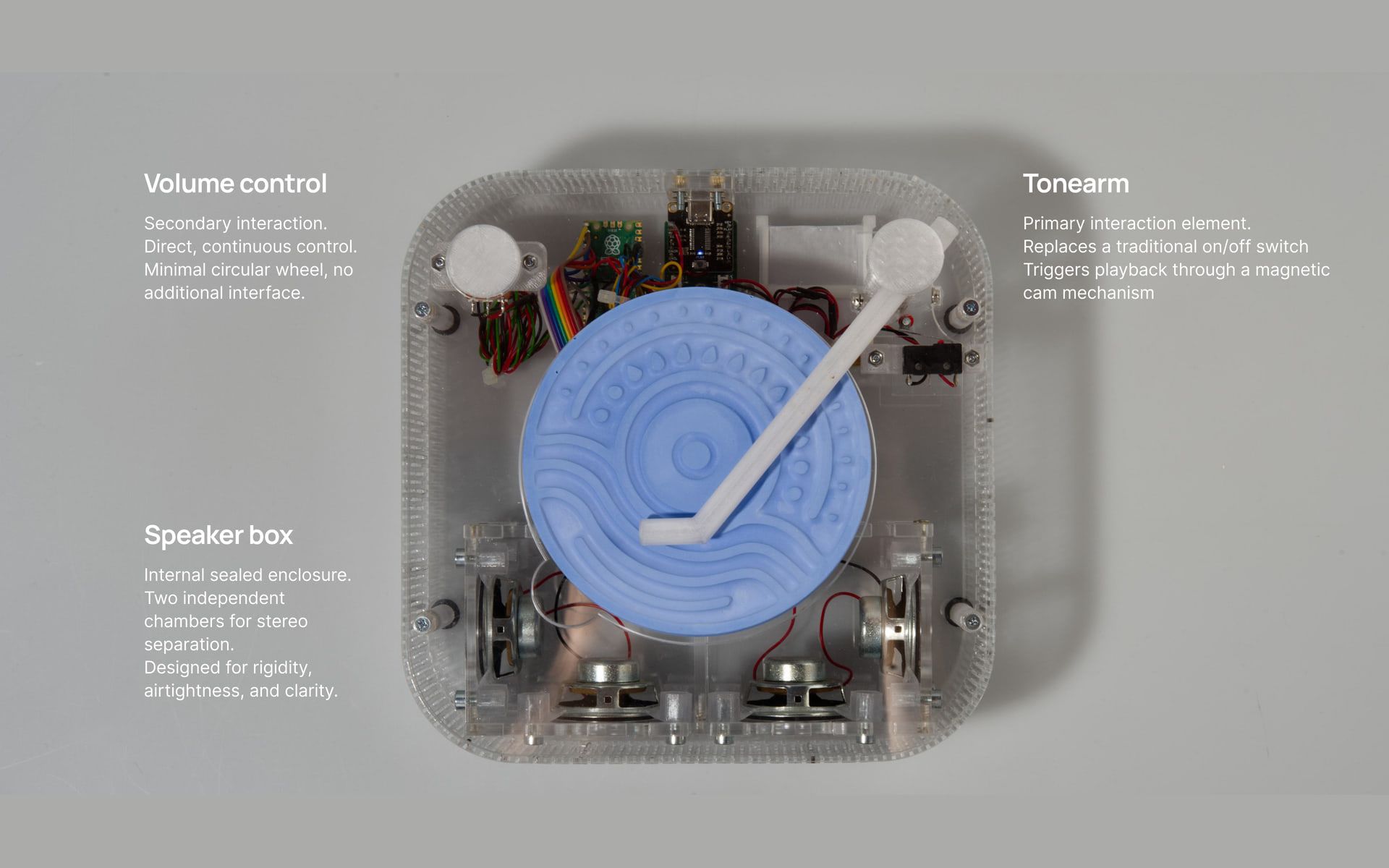
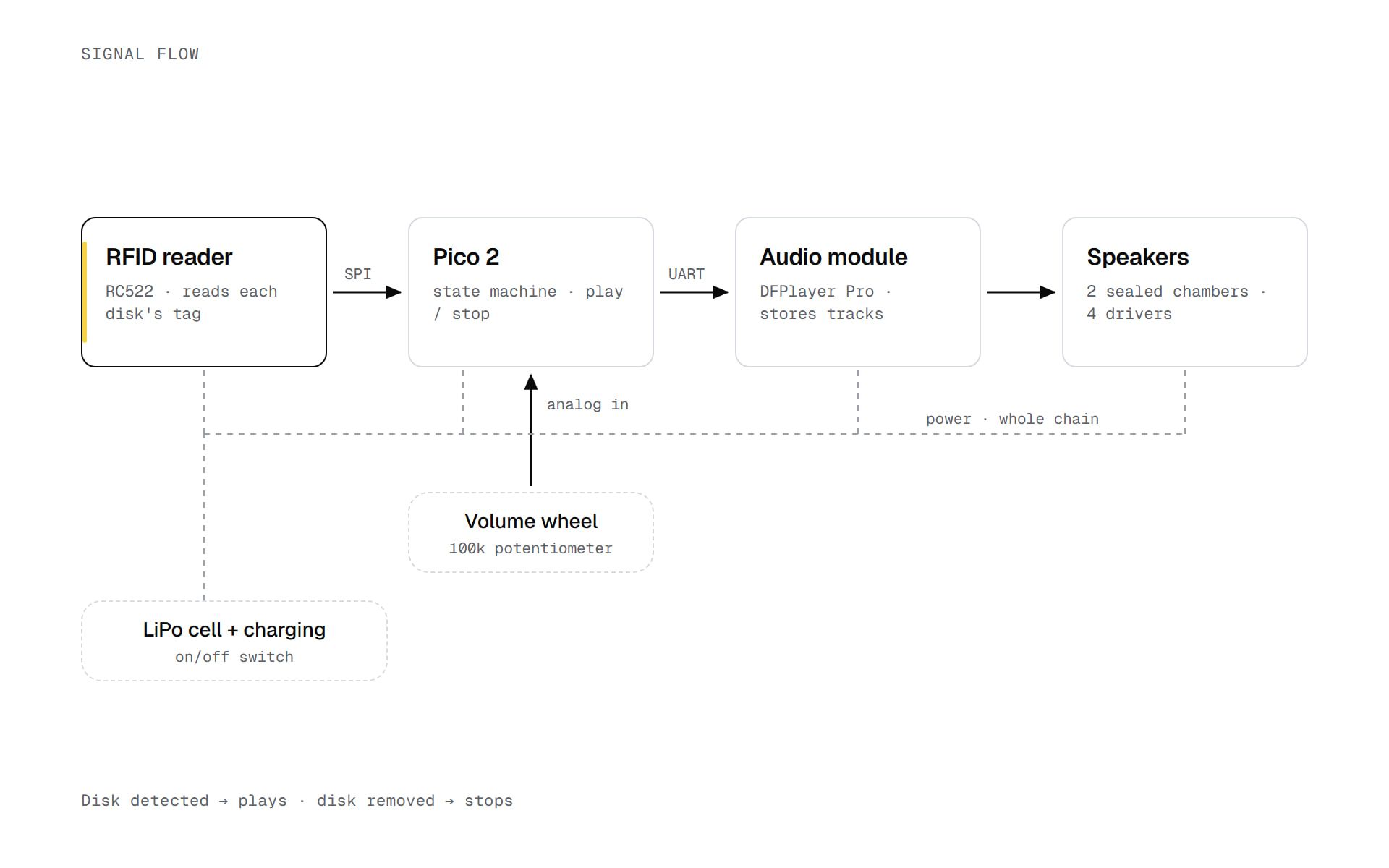
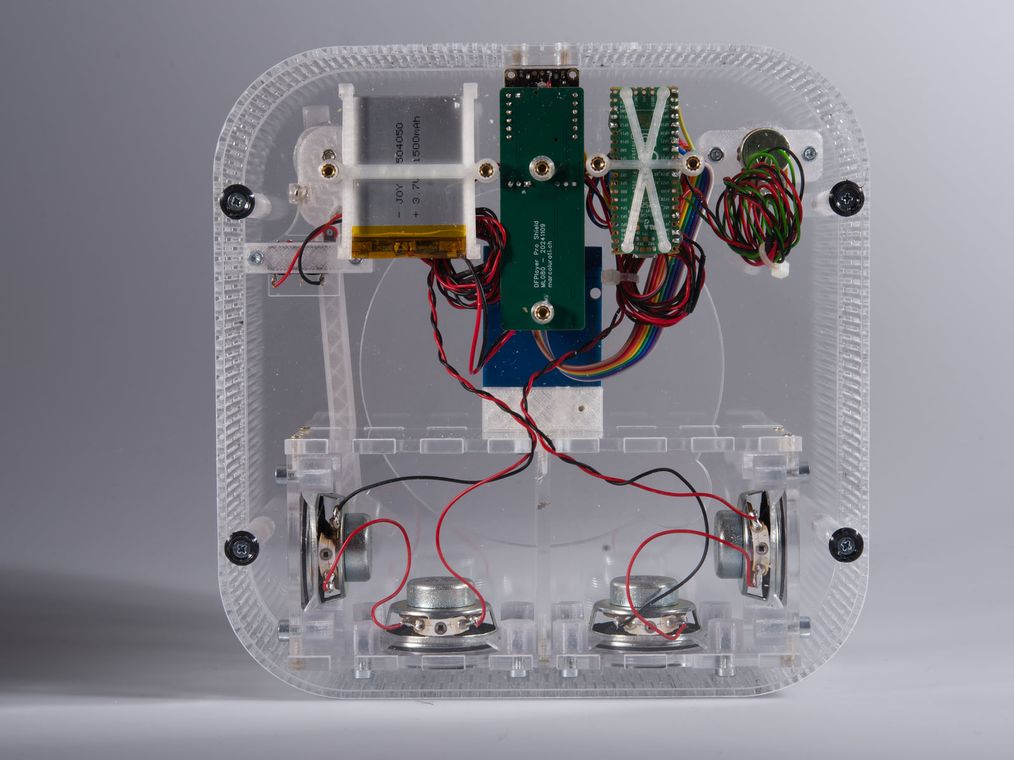
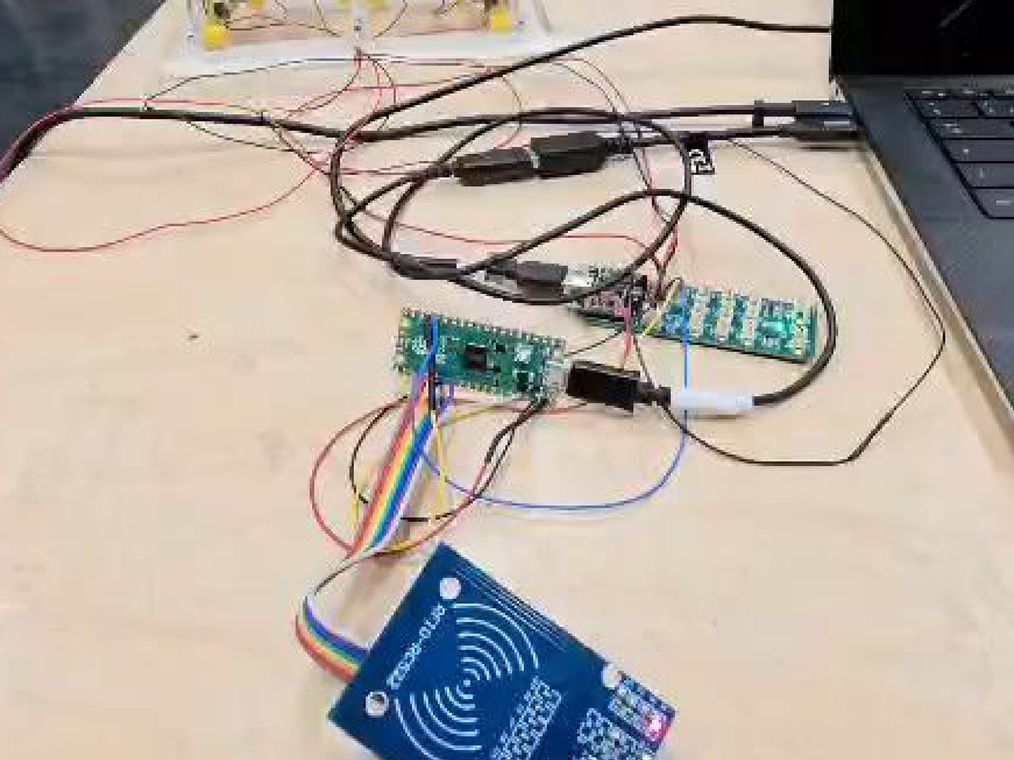
My core contribution was the electronics, built around one goal: placing a disk should automatically start the right soundscape. An RFID reader identifies each disk by a tag, a Raspberry Pi Pico 2 runs the state machine, and an audio module stores the recordings and drives the speakers. Disk detected: it plays. Disk removed: after a short threshold, it stops.
I validated the whole chain on the bench before committing to the build: reliable RFID polling, mapping each disk's tag to a track, audio control over a serial link, and the volume wheel mapped through the analog input. The firmware is modular, one piece reading tags, one routing them to tracks, one wrapping the audio commands, and a main loop holding the play-and-stop logic. A simple RFID module on a Pico turned the concept into a working system in a couple of hours, which is the part of electronics I still find quietly amazing.
Sound inside a transparent shell
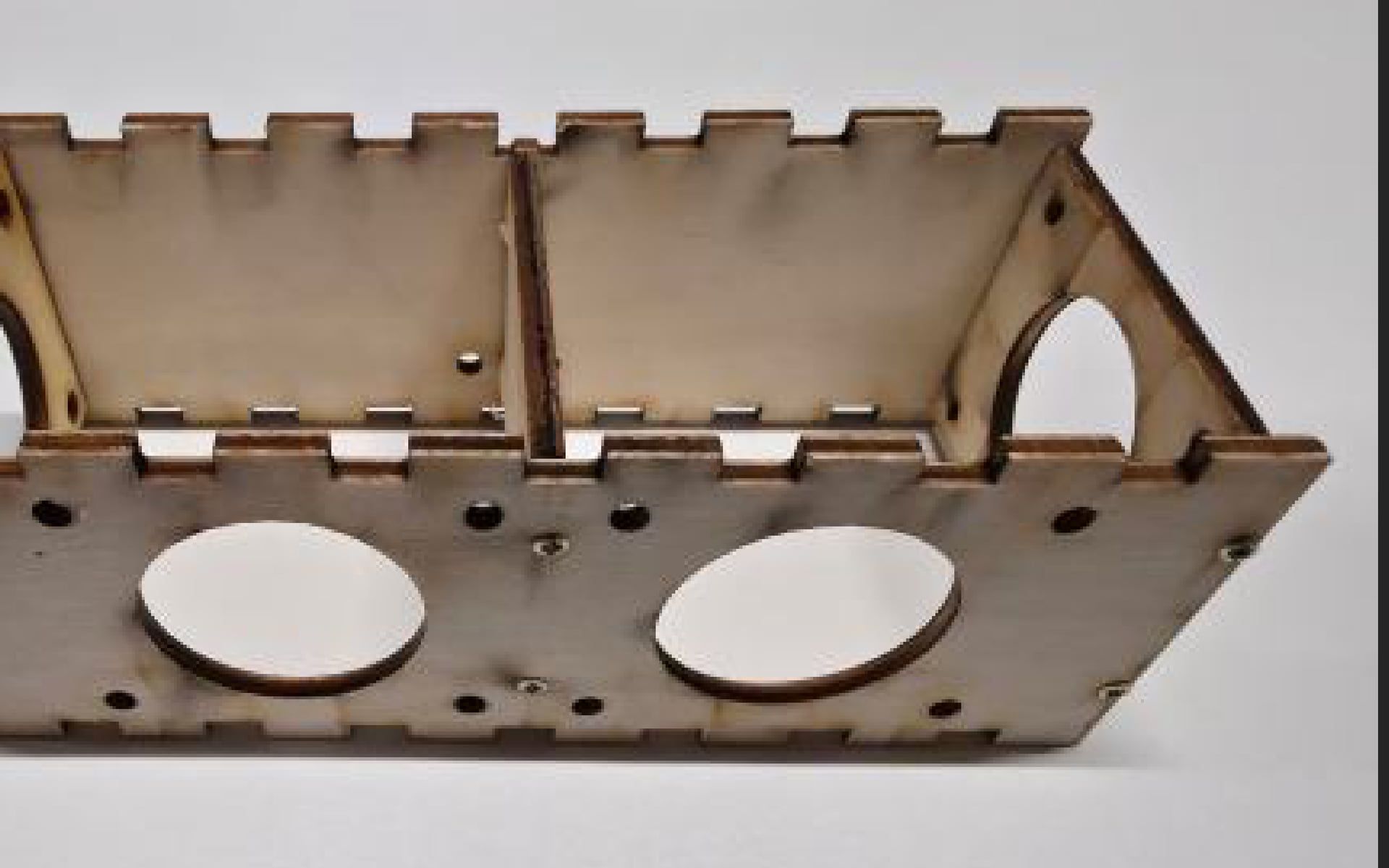
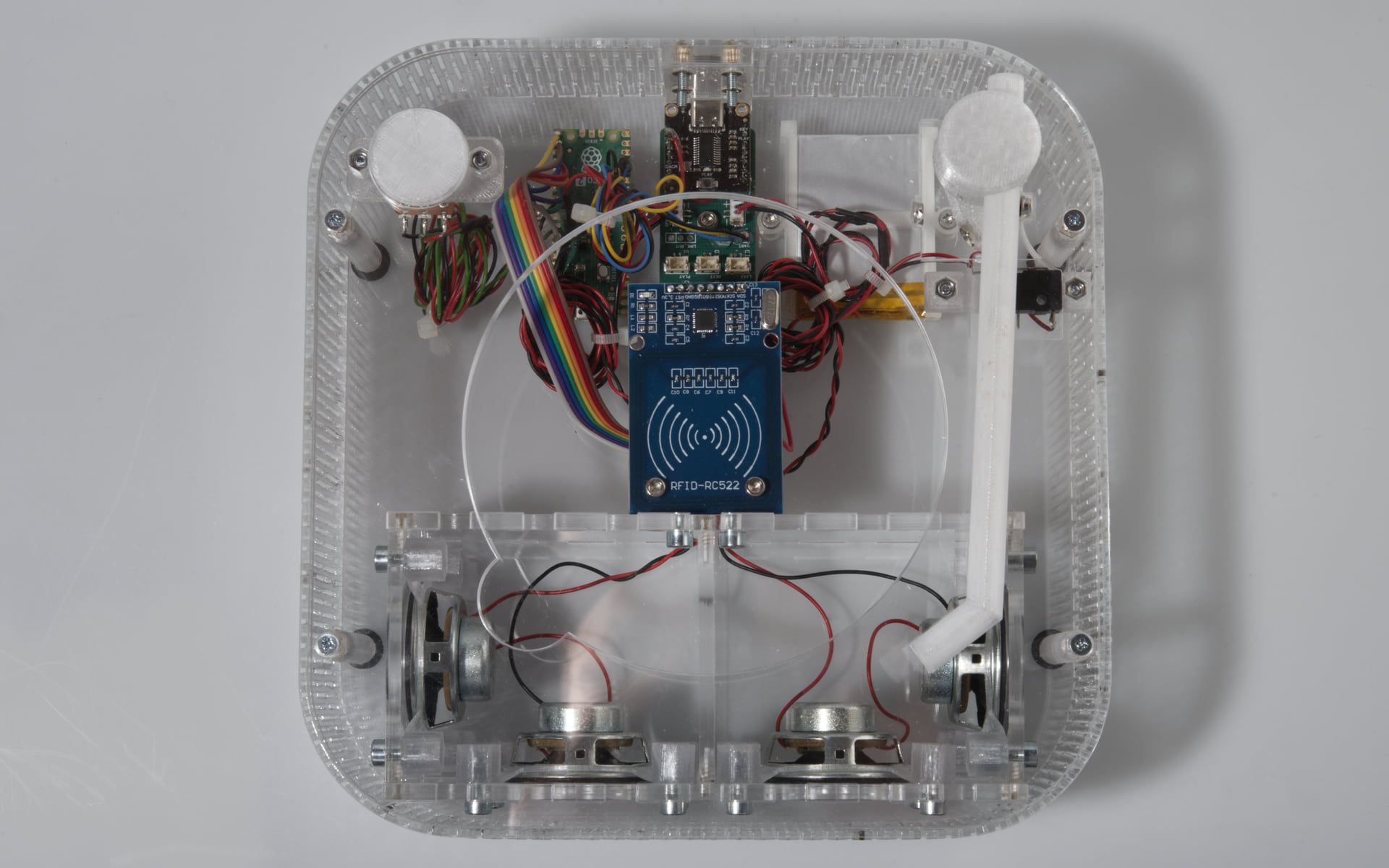
The object is transparent on purpose; its construction is part of the experience. That left nowhere to hide a speaker or a cable, which made the audio enclosure the hardest integration problem. We designed a compact internal speaker module split into two sealed chambers, two small drivers each, prioritizing airtightness, rigidity, and an assembly that comes apart without glue.
We worked up to it in stages: an acrylic single-speaker mock-up to check vibration and the printed clamp, a wood prototype of the two-chamber layout to validate alignment and the assembly sequence, then the final laser-cut acrylic. The boards mount inside on printed supports screwed into heat-set inserts in the acrylic, so the outer surfaces stay clean. The engineering only counts when none of it shows.
Disks you read by touch
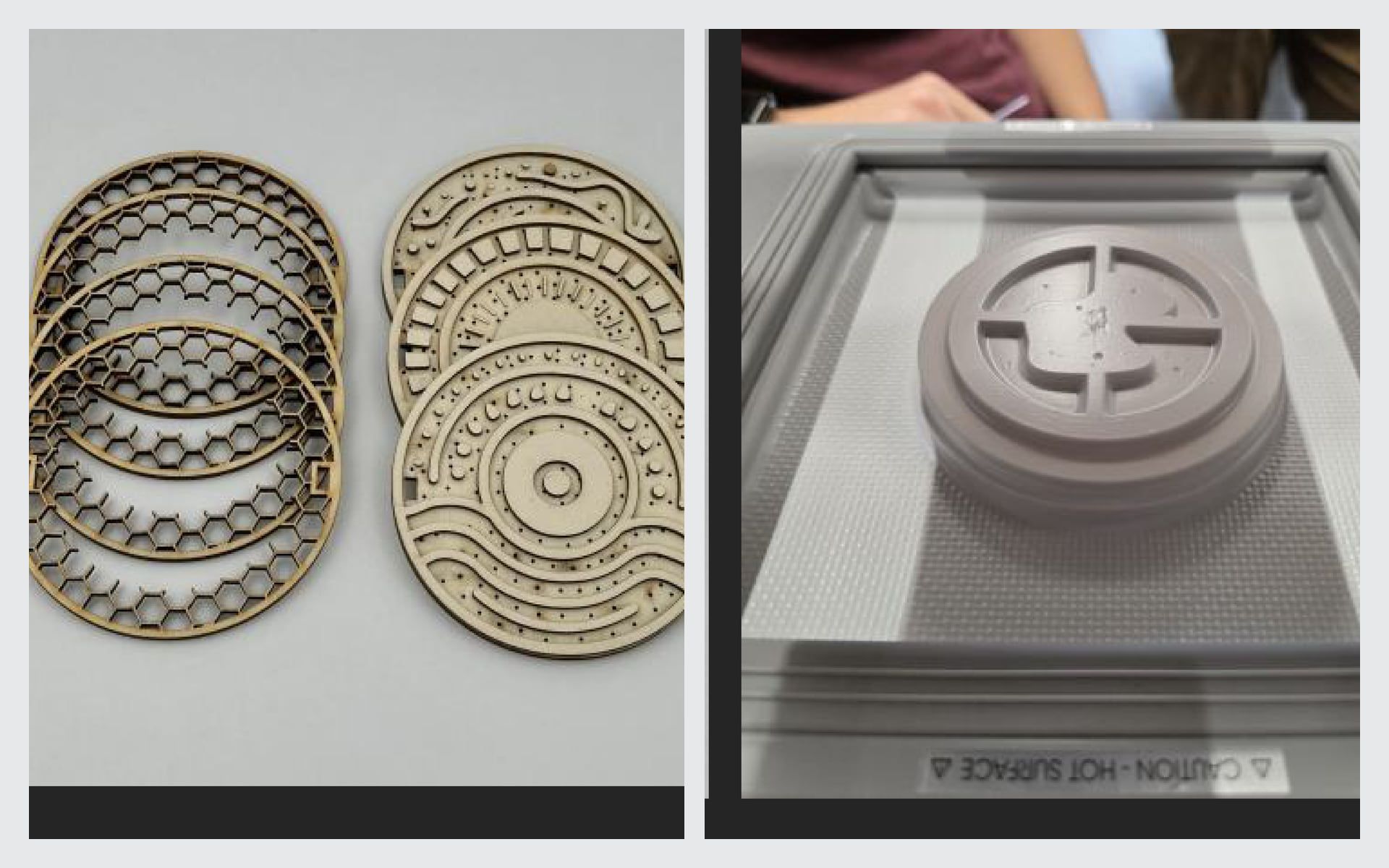
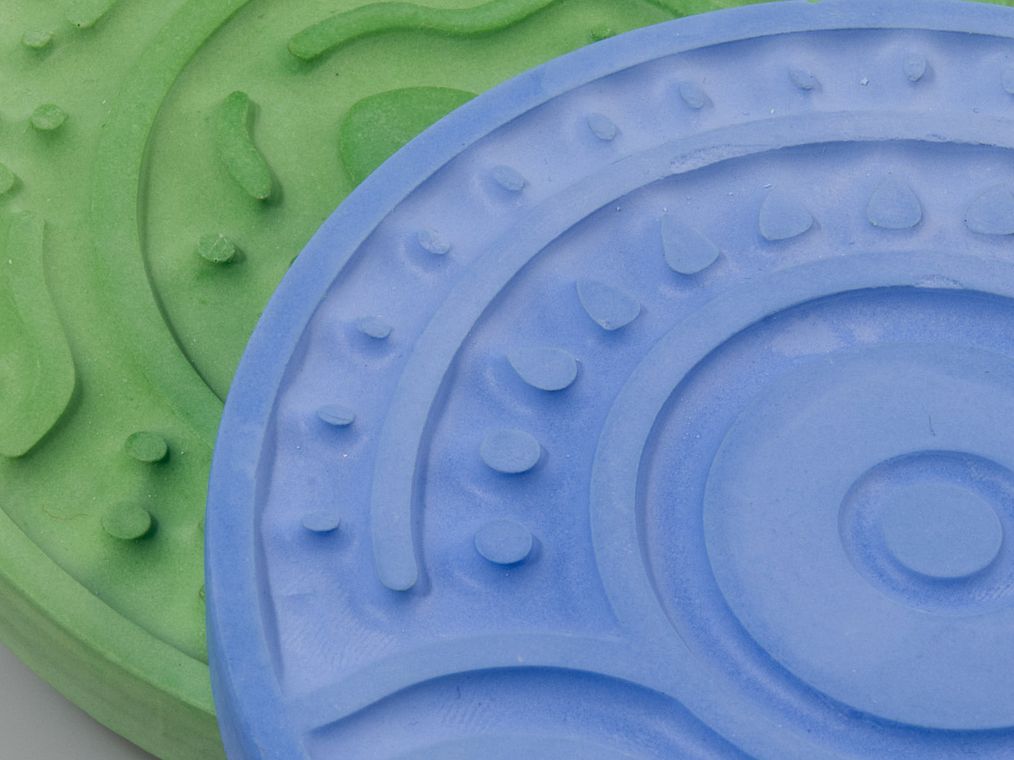
The disks are the heart of the concept, so they could not be the usual digital-fabrication palette of light plastic or laser-cut wood. The team chose plaster for its weight and its stone-like presence, tinted and textured so each place has an identity you recognize by touch and color before any sound starts. Touch becomes a real dimension of the work, not a finish.
Making them was its own small engineering problem, solved by the team with a laser-cut positive, a vacuum-formed negative mould, and pigmented plaster poured and released. The same appetite for unfamiliar materials shaped the body's belt, a continuous live-hinge strip that lets rigid acrylic bend around the whole object while staying acoustically open. Most of the project's time went into trials like these, and the object is better for it.
A working synesthetic object. Place a disk, move the arm, and a public place fills the room as a continuous atmosphere; lift the disk and it falls silent.
Three places realized (a park, a marina, a train station) from on-site field recordings made and edited for the project, each carried by a plaster disk you choose by touch rather than from a list.
A fully resolved physical prototype across electronics, audio, and fabrication, documented openly with the code and hardware files released under open licenses.
The lesson I keep from Human Loci is that a concept without purpose holds about as much value as cooking with ingredients that have no flavor. The deep ideation we refused to rush, and Marco's push to reinterpret rather than replicate, are what made the object mean something. The technical side rewarded the same patience: working with plaster, plexiglass, and vacuum forming for the first time only paid off because we let creativity lead first and turned pragmatic second.
- GitHubSource code and setup guide (opens in new tab)
- PDFElectronic schematic (opens in new tab)
- WebPrototyping process (opens in new tab)